The restaurant Vin Mon Lapin is on every foodie’s radar in Montreal. People come from across the country and the US to try it. It’s won a ton of awards for both its food and wine program. And I have a huge amount of respect for sommelier Vanya Filipovic and chef Marc-Olivier Frappier and their team. But I’d always stayed away, mostly because of my food intolerances. The menu just never seemed very me-friendly, and the worst thing is for the kitchen to have to adapt its manu so much that it stops being interesting, like removing half the ingredients from a dish until you’re left with just tomatoes. For transparency, it sucks serving me, because I’m intolerant to gluten, oats, dairy, raw onion, raw garlic, coconut, beef, pork and caffeine (including chocolate and coffee).
But it was a special night and my partner got an early reservation, so we decided to cross our fingers. Because great kitchens are generally able to adapt if they have time and resources. Which they did. They even knew in advance whch dishes I could have, and that was the first thing my server told me. I could have five of the dishes. Great, I said! So I got those. I split four of them with my partner, and he got two extras.
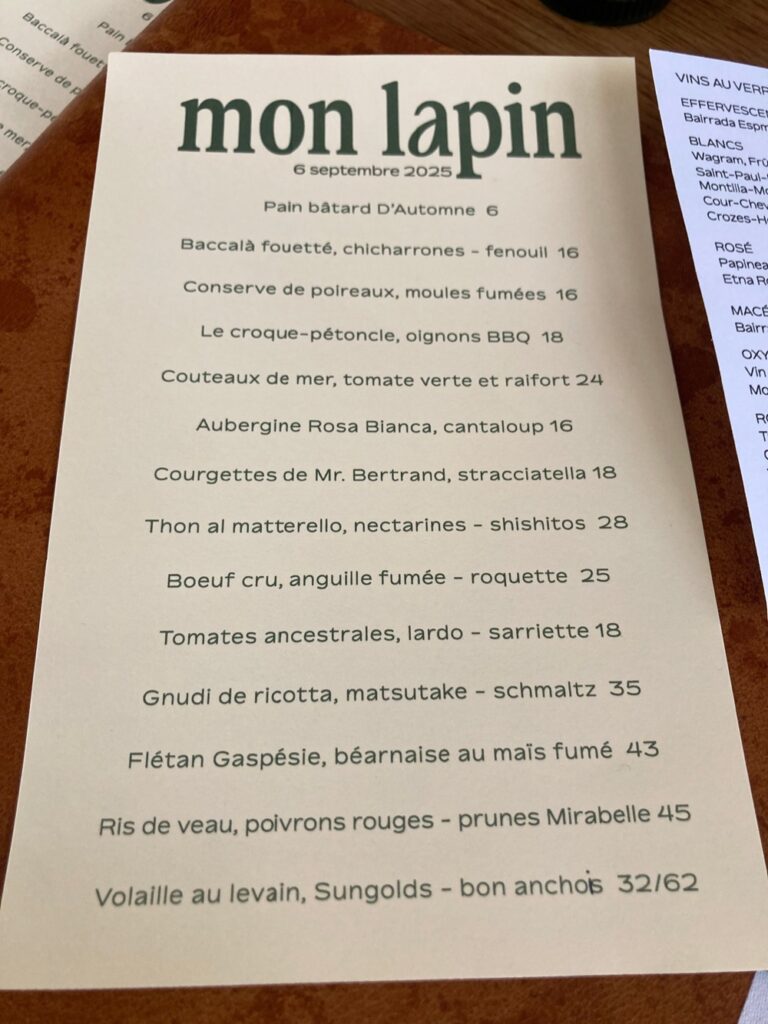
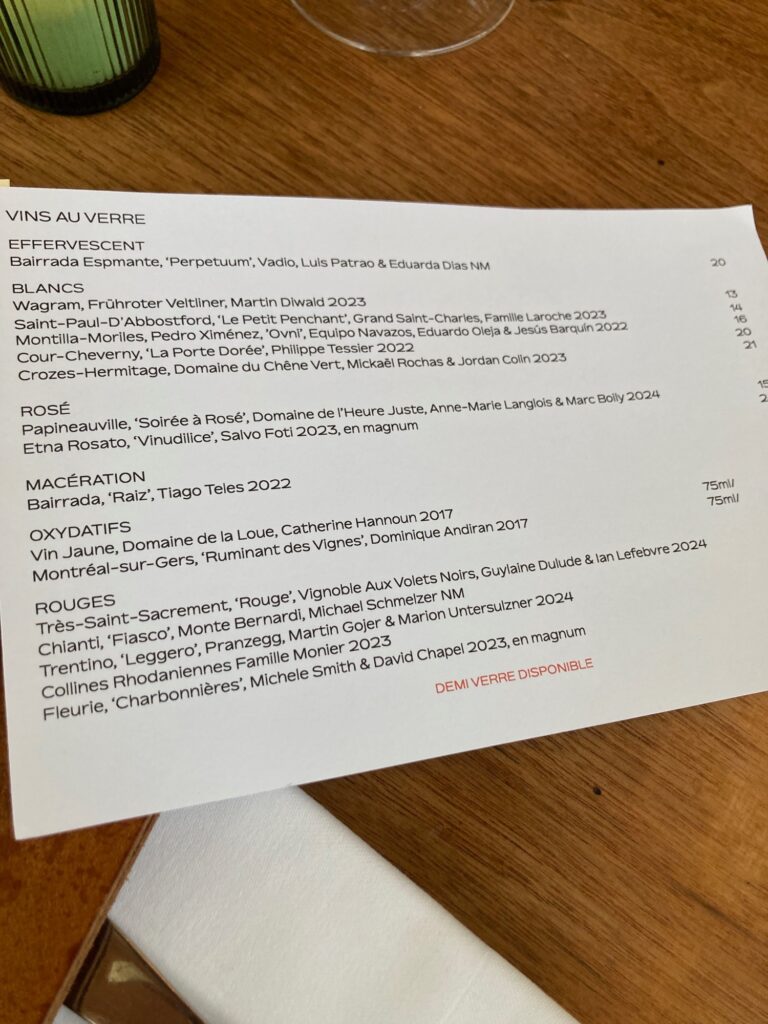
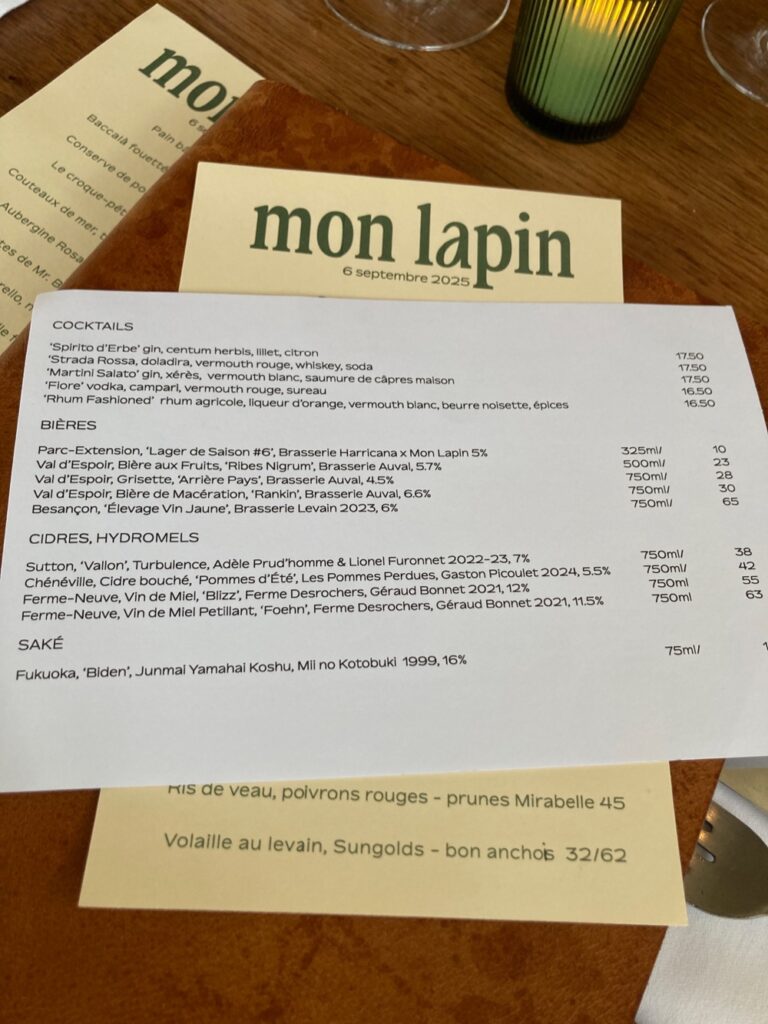
Here are the menus and the descriptions:
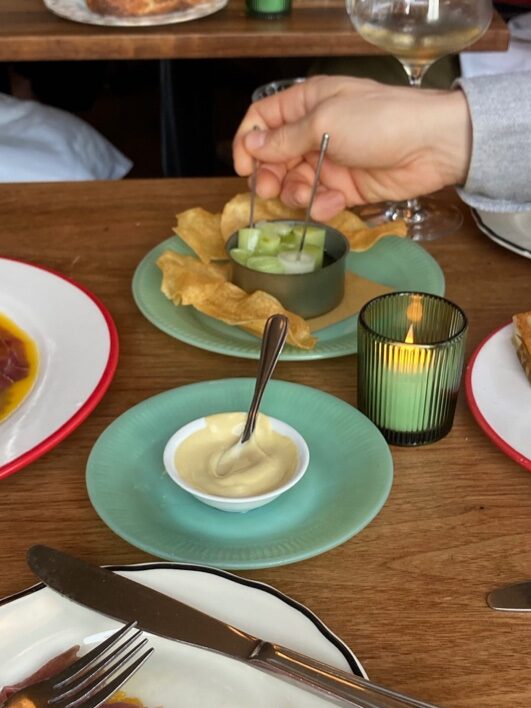
Mussel mousse with leeks and potato chips
The presentation on this dish was a fun surprise. There was nary a mussel in sight. Instead, there was a pot of something between a mussel mousse or a creamy mussel spread, accompanied by a dish of one-inch tall cylinders of braised leek with a touch of vinaigrette and some long slices of potatoes fried into cirspy, salty chips, but a little thicker than store-bought, so better able to hold up a smear of mussel mousse and a piece of leek, which was how we were told it’s best eaten.
There was supposed to be habanero oil in the leeks, apparently, but all we got was dark green, sweet leek flavour, which was simple and lovely. The little bit of vinegar cuts through the oil, which was nice. The mussel mousse/sauce thing on its own was a bit funky, not in a bad way when you combine it with the sweet leeks and the crunchy, salty chips (which were perfect chips, no burnt or undercooked or unsalted portions). So putting some mousse and some leek on a long piece of potato had a great balance of crunch and salt and sweetness and umami. But then the wine pairing didn’t work. A light Austrian one with a German varietal that I liked on its own but that overpowered the leek.
Tomatoes with fried marjoram and tomato vinaigrette
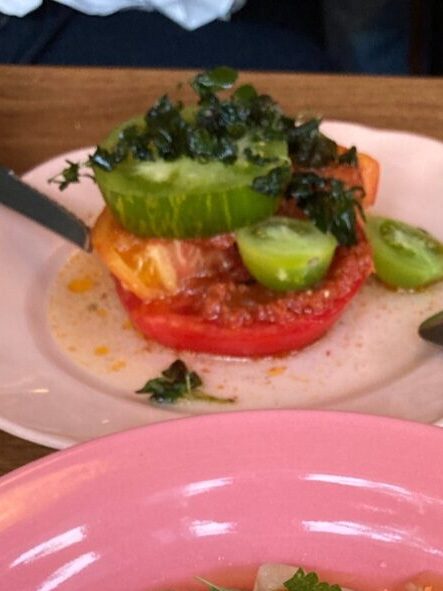
These were fine. They were tastier than plain tomatoes because of the vinaigrettre. It didn’t have the lardo, though, because of my pork intolerance, so it was a bit underwhelming. The dish was beautiful: Three types of heirloom tomato (one horizontal slice of giant beefsteak or Brandywine-type tomato, a small green, circular one, and a medium Brandywine type. They were lovely with the vinaigrette and crunchy marjoram, but really just tomatoes in a vinaigrette. I mean, I love a good heirloom tomato, but I grow a lot of them. I wouldn’t have ordered the dish except the server said it’d be more interesting than the zucchini dish without the stracciatella cheese. I’d even asked what would be on the tomatoes, then, and he said there was a vinaigrette and and some other tomato preparation, so it sound interesting, but I guess it’s just more on the subtle side without the pork slice. I imagine tons more work went into the vinaigrette than I know, but it’s really a simple dish, so there was no wow-factor halfway through the meal. I think, in my case, because removing the lonza made the dish so simple, it would have been better served earlier in the meal as a refreshing starter.
P.S. The Portuguese bubbles were fine, but just tasted like cider made with the Méthode champenoise. We’d decided to do four half glasses paired throughout the meal, and the server started us with these bubbles, the by-the-glass sparkling wine option that evening. I’d never had the grapes before and it wasn’t Spanish cava, so I was intrigued. But it just didn’t taste like wine to me, just like quality cider, which is not what I expected. This was a world away from Cava because of that apple flavour, so it’s not about the fact that it wasn’t “real” Champagne. I just don’t find cider that exciting. It was cool to try a Portuguese sparkling wine, though, I guess.
Tuna and nectarines
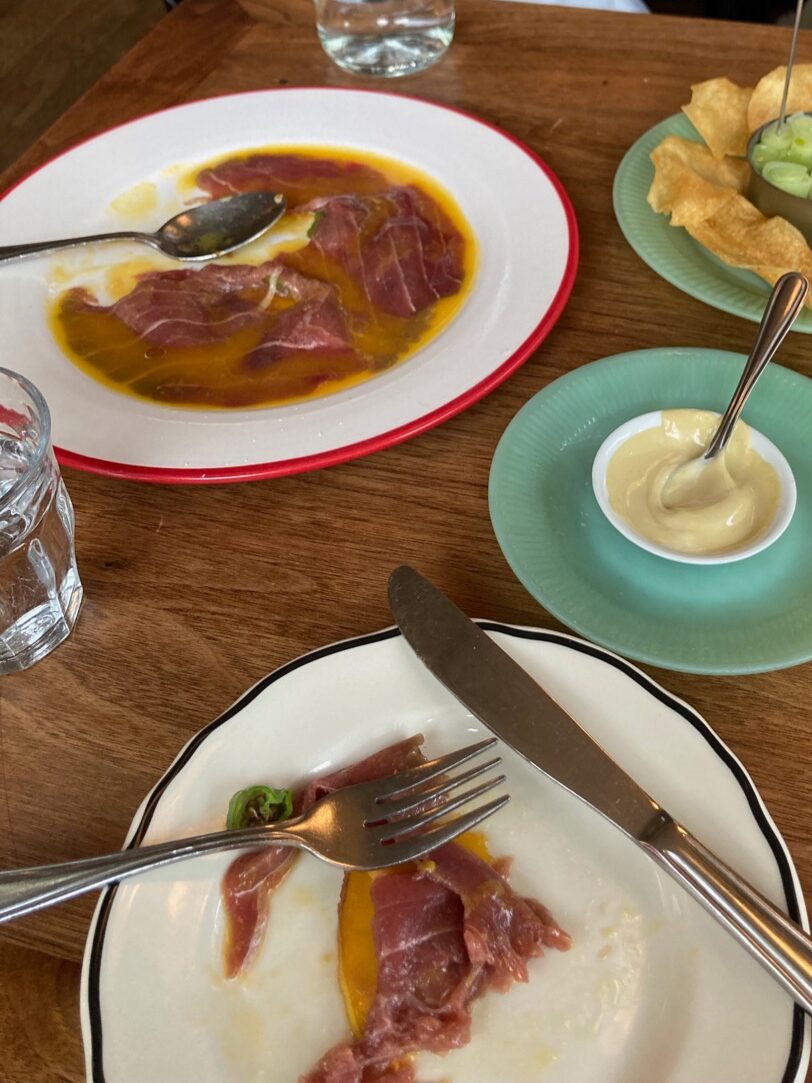
This dish was just strange and bland. The main problem was there was no salt. So it was top quality tuna but the sweet nectarine sauce covered any chance of flavour, and the lack of salt made it so the fish had no chance of cutting through. Maybe it needed anchovies? But the tuna just wasn’t strong enough. There were also some pieces of shishito peppers in there, but they had a wimpy take on being “charred.” In fact, they mostly tasted and looked raw, though we did pick through and found some black bits, so we knew that the intention was to char them, but that flavour didn’t come through. And the white wine we had with this just didn’t work. That’s all I can really say. It was a nice wine on its own, just not together.
Scallop sandwich

My partner liked his scallop sandwich, but he said the dipping sauce was weird. It was better without it.
Eggplant and cantaloupe
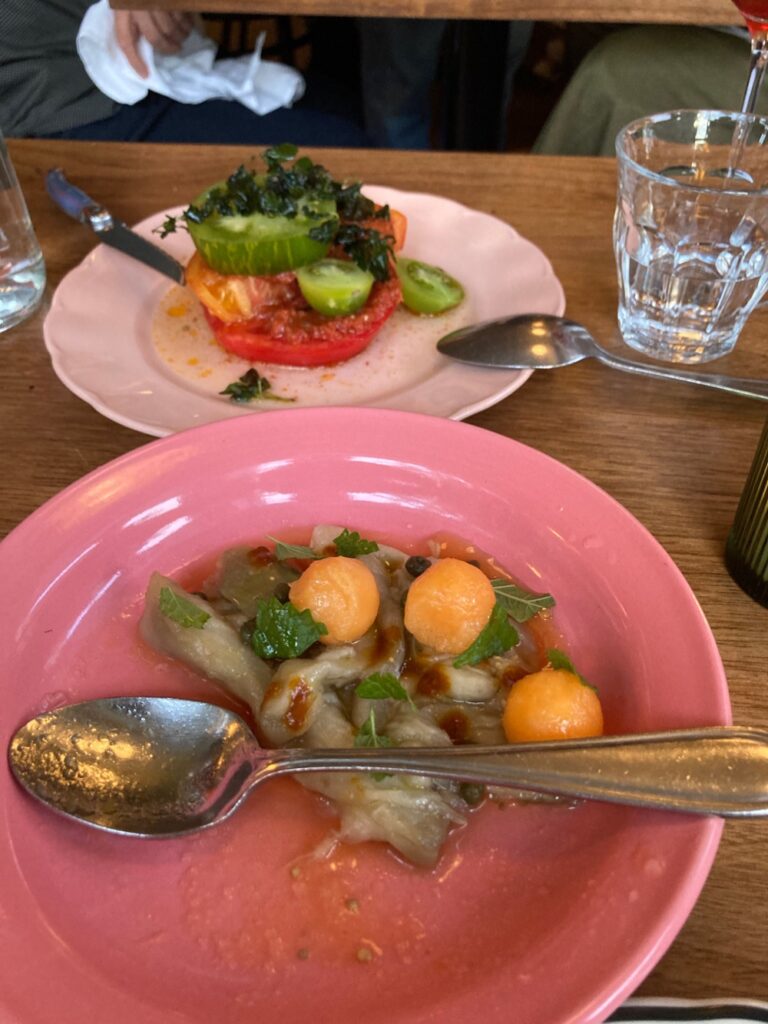
Okay, let’s talk about the eggplant. In no world should tender eggplant flesh have been paired with super-sweet cantaloupe balls. The fruit was just way too sweet, which was incredibly off-putting on its own, and then with the Mélisse (lemon balm), it was absolutely disgusting. Yes, I used that word. I’m veyr sorry, but that’s what it was to us. Combining capers and cantaloupe, I understand – it’s like melon and prosciutto, a classic sweet-and-salty combo. The capers and eggplant combination I get, too, because it’s salty and acidic, which the eggplant can almost handle, even though the vinegar in the capers overpowered the mild eggplant flesh a bit in this case, but fine. But the lemon balm should never have been in that dish. The thing about lemon balm is that it tastes medicinal and bitter. It doesn’t taste like sorrel, with has a lemon-y flavour. Even that would have been too violent a flavour in this dish. The outcome was that I never thought I’d say “this is awful” in this restaurant. I know the kitchen is incredibly talented, I appreciate the commitment to local and changing ingredient combinations, sauces and entire dishes seasonally, but this just did not work.
And the wine pairing actually made things worse. A light red. That’s all I remember. Very gentle and pleasant on its own. But not friendly with that dish, to understate it. Better would be to say the wine and the dish were all-out playground enemies. My nose is currently wrinkling at the mere memory of a sip of that wine and a mouthful of that cantaloupe, lemon balm, capers and eggplant.
Steamed halibut with corn
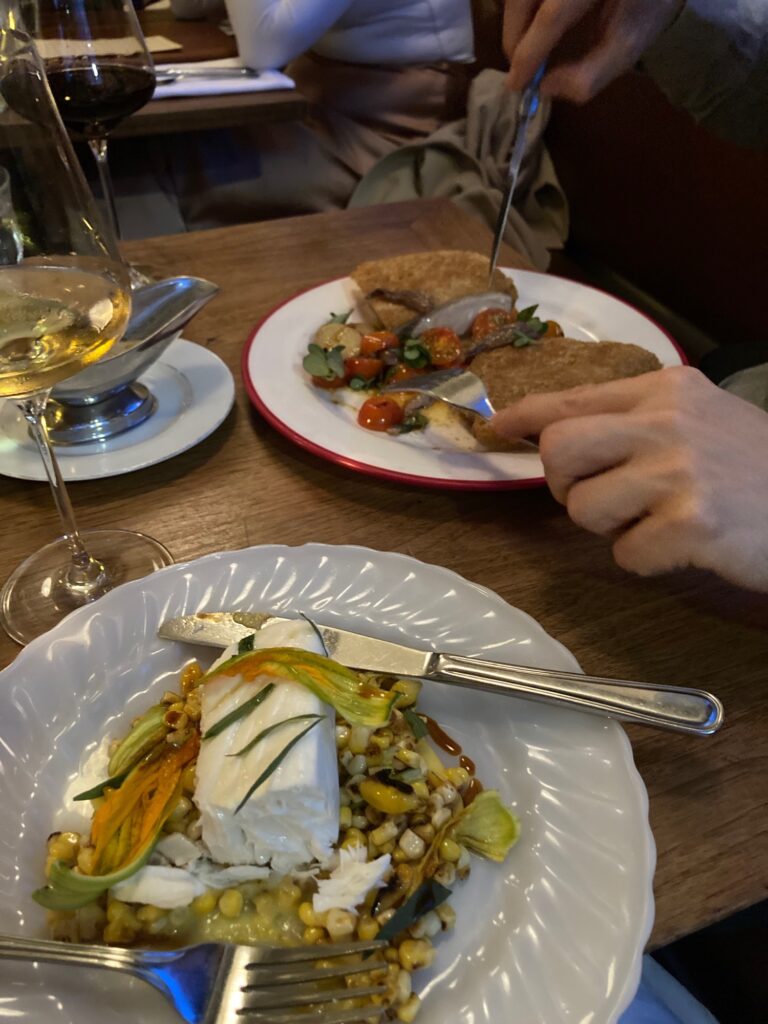
Guess who decided to finally come to the party? The habanero oil! (I think.)
The spicy oil was the most interesting part of my main course – a thick piece of steamed halibut with charred corn (the char was, again, mostly aesthetic, not flavourful), a creamy corn sauce spiked with Dijon and hot pepper oil and topped with a decent spritz of chicken jus.
What was most impressive was how the halibut was seasoned the whole way through, not just at the edges. My guess is it was briefly brined, because it was definitely not cured, but I could taste salt on the middle pieces of flesh.
But because it was steamed and there was no other seasoning on the fish, so I ended up finding the eating monotonous because each bite of the whole large, tender piece tasted exactly the same. Fortunately, the other elements of the dish added intrigue. The pepper oil added surprise punches of low-level heat. And although I couldn’t decide if I liked that the Dijon stuck out in some bites of the corn purée while others bites of the purée were bland texture, I at least really liked the bites with the pepper. You couldn’t see the pepper oil, though, so you never knew when that would be. The best bites, though, were the ones that had that super-rich, deep, chicken jus flavour. It was the element that made the dish feel indulgent, despite the light cooking method. (I’m assuming the jus didn’t come from the sourdough chicken – more on that below).
So, the takeaway for this steamed halibut dish is that I enjoyed the surprise of the dijon/oil/jus when it came, because I never knew when I’d have a delicious bite, but the opposite was also true: I never knew when I’d have a bland one. Remember that all the elements of this dish were soft and warm, so without a flavour pop, it stops being interesting. I’m not sure the customer should have to hunt for excitement in a dish, but maybe it would have been too monotonous otherwise? I’m not sure.
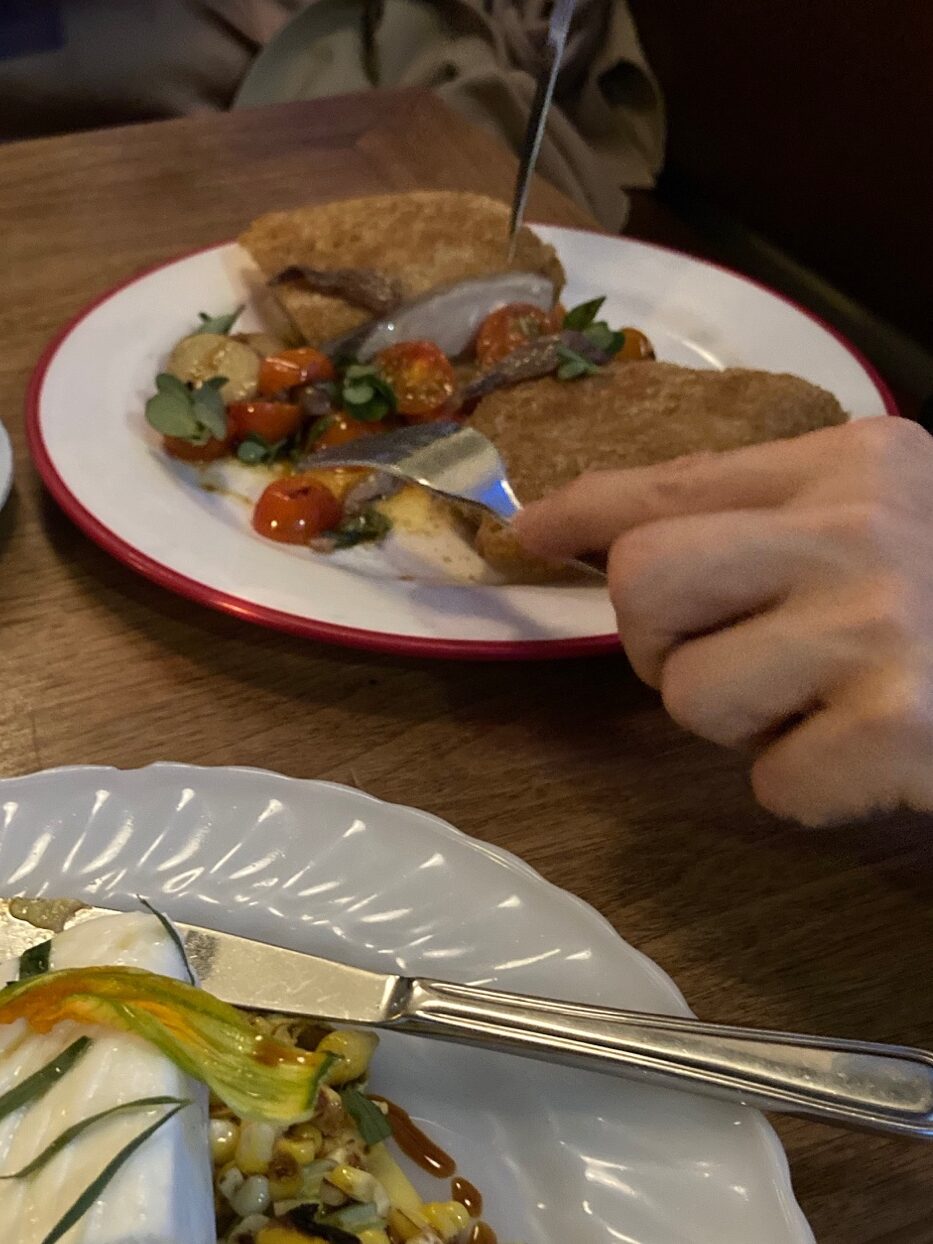
Speaking of that chicken, my partner had the sourdough half chicken, and he was very happy. He got a very generous amount of that delicious chicken jus (though I can’t confirm that it was the same) along with his giant serving of incredibly crispy-skinned chicken (it seemed as though the skin may have been separated from the meat, so it was extra crispy when laid back on top). It came with potatoes and vegetables – a meal on its own, not just protein + sauce.
If you’re thinking I was very jealous of the carbs and the texture, I was. My halibut dish was also more expensive, which I understand because halibut is a very expensive fish and it was excellent quality. But the chicken was the winner, and I say that without even trying it.
The chicken was also the winner because the wine pairing finally worked, said my partner. The pairing was a fruity red wine that he didn’t love on its own but actually amplified the meat and jus. My theory is that this dish has been on the menu so long that all the servers (who are very well-trained on the wine, of course) know what wines work with this dish, whereas the other, newer dishes are always changing and good luck finding a canteloupe-lemon-balm-caper eggplant pairing on a few day’s notice. Medicine, sugar, bitterness, and vinegar. I get it, it’s a hard combo. Chicken? That’s easy.
My partner’s verdict? He’d go to the Rotisserie La Lune for chicken and skip the fancy Mon Lapin next time. My verdict? I’ll make roast chicken at home because at least then I can eat the side dishes. Maybe that’s what I should have done last night. I really do appreciate that the kitchen identified the five dishes that I could have in advance, but when only one or two of them are tasty, and not even that interesting, I won’t be back. Maybe the restaurant just isn’t meant for me. Because if I’d been able to eat the classics – the scallop sandwich, the chicken – I would have been more likely to be impressed.
I know it’s hard to live up to hype, and Mon Lapin certainly has hype, but at a restaurant that prides itself on its wine program, to not have a single pairing that I felt actually worked was disappointing. It’s hard for the customer when the wine is poured before the dish appears, but that’s why you have to trust the server, who’s supposed to have tried the pairing in advance. It was extra hard for me because I wasn’t even told what my dishes contained, just that the kitchen was planning to adjust them for my intolerances. So I really had to rely on my server, who was very knowledgeable and tried hard, but also couldn’t predict the pairings.
One other note: It would have been nice to know what changes the kitchen was going to make to my dishes. This restaurant is known for its wonderful descriptions of its dishes. They’re known to go into the cooking and sauces and ingredients like my grandfather reciting the family history – that is to say, enthusiastically. I got nothing. I was okay with trusting the kitchen, because, I figured, if there was ever a kitchen in Montreal to trust, it was this one. But if you’re going to go to the trouble of telling me what dishes I can have, then you’ve obviously thought about any adjustments, so am I not worthy of knowing what those are and getting some tantalizing descriptions, like all other customers? The truth is that I felt lesser.
I want to say that with gluten, oats, dairy, pork, beef, raw onion, raw garlic and coconut all off the table, it’s my fault for even thinking I’d have a great meal, but the truth is that I’ve had plenty of excellent meals at restaurants that need to adjust dishes for me. That’s why I warn them in advance and I hope they’ll tell me if they’re not able to. I really appreciated that the server warned me away from the zucchini and stracciatella because the zucchini wouldn’t be exciting on their own, but some of the dishes weren’t even changed. I even asked our server whether something in the tuna dish had been changed for me, because it was weird that it didn’t have enough salt, like it was missing a salty element and was off balance. Nope, that was how it was supposed to be. “Did I want salt brought?” asked my server. Goodness, no! I would never be that person. If the kitchen wanted to salt something, they would, theoretically. And yet, I don’t know what happened here because the other dishes were all properly seasoned. My intolerances should have nothing to do with that.
One last thing: Even though I didn’t love the wine or the wine pairings, I really did enjoy tasting wines that were completely different from what I’m used to. I wanted the server to be right about the pairings. I was hoping that funky macerated loureiro would add depth to the fish. And the light red would make the eggplant caponata-like. They just didn’t. But it was cool to try. Just, when you’re paying $300 for a meal, the professional pairings should be (at least, mostly) successful, not just interesting.
I know a lot of people will disagree with this, and that’s fine. I just think it’s important that not everyone will have the same experience here, and to explain why that may be. So, go, stick to the classics and play it safe with pairings, or roll the dice on new dishes, which may be good or not. Most people will probably think they’re just fine. I just didn’t. So if you’re a snobby diner with a bunch of food intolerances, you might be better off spending your money elsewhere, that’s all.
Leave a Reply